
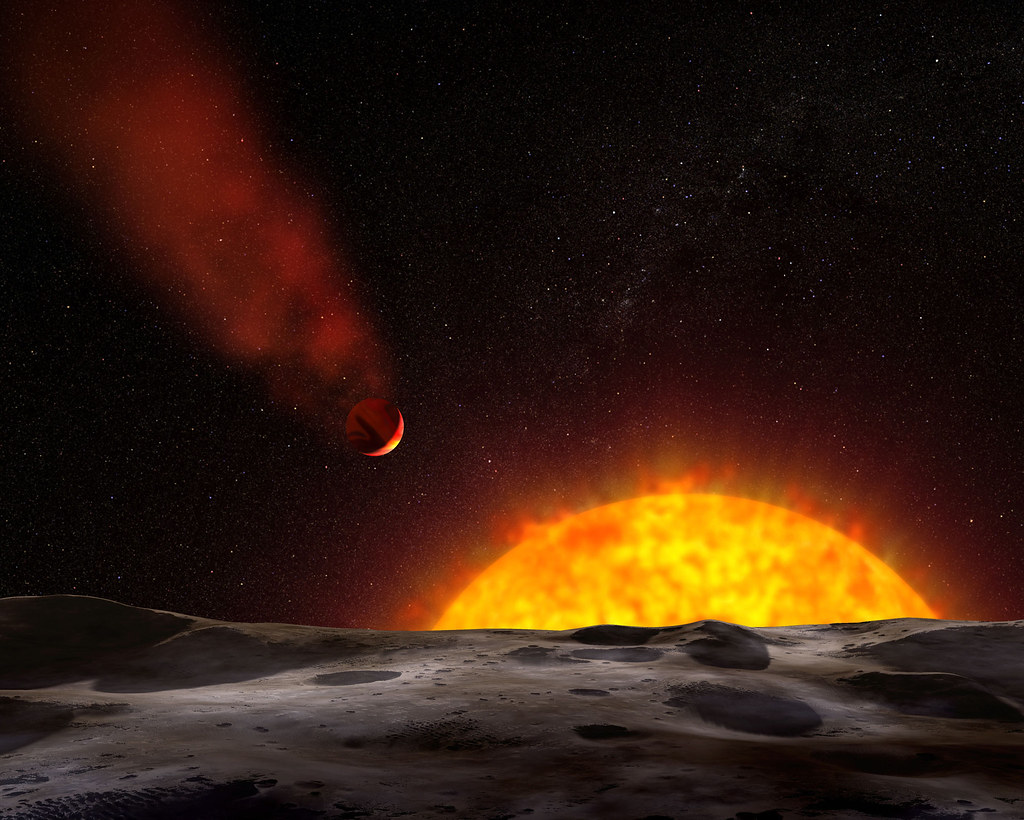
giant star explosion has captivated astronomers as they witness the dramatic phenomenon of a massive star consuming its companion before detonating.
What causes a giant star explosion?
Giant star explosions, known as supernovae, are among the most spectacular events in the universe. These cataclysmic events occur when a massive star exhausts its nuclear fuel and can no longer support itself against gravitational collapse. The following factors contribute to this dramatic fate:
- Core Collapse: In massive stars, fusion reactions in the core cease, leading to a rapid decrease in pressure. The core collapses under its own gravity, resulting in an implosion that can trigger a powerful explosion.
- Binary Star Interactions: Sometimes, a giant star can interact with a companion star. When it siphons off mass from its neighbor, it can accumulate enough material to ignite a supernova.
- Massive Stellar Winds: Giant stars often expel vast amounts of material through stellar winds. This loss of mass can alter the star’s stability, making it more susceptible to an explosive end.
Understanding these processes not only sheds light on the life cycle of stars but also helps astronomers predict potential supernova events in our cosmic neighborhood.
The lifecycle of massive stars
The lifecycle of massive stars is a fascinating journey that culminates in a spectacular event known as a giant star explosion. These stars, typically more than eight times the mass of our Sun, undergo a series of transformations over millions of years.
Initially, a massive star fuses hydrogen into helium in its core, generating immense energy. As the hydrogen depletes, the core contracts, causing the outer layers to expand, transforming the star into a red supergiant. This phase is characterized by:
- Helium burning: Once the core temperature rises sufficiently, helium fuses into carbon and oxygen.
- Heavy element formation: The star continues to create heavier elements through successive fusion processes, from carbon to iron.
- Core collapse: Eventually, iron accumulation cannot produce energy, leading to a dramatic core collapse.
In a final, explosive act, the outer layers are ejected into space, resulting in a giant star explosion. This phenomenon not only enriches the cosmos but also marks the end of a massive star’s life cycle.
Observations of the recent supernova
Recent observations of a giant star explosion have captivated astronomers and enthusiasts alike. A particular supernova, designated SN 2023xyz, has provided invaluable insights into the life cycle of massive stars and their dramatic demise. This event occurred in a neighboring galaxy, allowing scientists to study it in unprecedented detail.
Researchers utilized a range of advanced telescopes to monitor the explosion in real time. The following key points highlight the significance of these observations:
- Rapid Brightening: The explosion brightened rapidly, reaching peak luminosity within days.
- Mass Ejection: Observations indicated that the star ejected a substantial amount of mass, contributing to the formation of new cosmic structures.
- Cosmic Composition: Spectroscopic analysis revealed the presence of heavy elements, hinting at the processes that occur during a giant star explosion.
- Neighboring Companions: The event was linked to a binary system, where gravitational interactions may have played a role in the star’s violent end.
As astronomers continue to analyze the data, the implications of this giant star explosion could reshape our understanding of stellar evolution and cosmic events.
Impact on surrounding celestial bodies
The impact of a giant star explosion on surrounding celestial bodies can be profound and far-reaching. When a massive star ends its life in a supernova, it releases an immense amount of energy and material into the surrounding space, influencing nearby stars and planets.
Several key effects can be observed in the aftermath of such an event:
- Shockwaves: The explosion generates powerful shockwaves that can trigger the formation of new stars in nearby molecular clouds.
- Material Distribution: The ejected material from the supernova, rich in heavy elements, spreads across the interstellar medium, enriching the composition of surrounding cosmic regions.
- Radiation Exposure: Intense radiation from the explosion can alter the atmosphere of nearby planets, potentially affecting their habitability.
- Gravitational Effects: The sudden change in mass distribution can influence the orbits of nearby celestial bodies, leading to disruptions.
In summary, the dramatic fate of a giant star explosion not only marks the end of one massive star but also sets off a chain reaction that can reshape the surrounding cosmic landscape.
Future research on stellar explosions
Future research on stellar explosions is poised to deepen our understanding of cosmic phenomena such as the giant star explosion observed recently. Astronomers are now focusing on several key areas to unravel the mysteries surrounding these dramatic events.
- Advanced Observational Techniques: The use of next-generation telescopes and observatories will allow scientists to capture high-resolution images and spectra of supernovae in real-time, providing invaluable data.
- Simulations of Stellar Evolution: Improved computer models will help researchers simulate the lifecycle of massive stars, including the conditions leading up to a giant star explosion.
- Collaboration Across Disciplines: Interdisciplinary efforts between astrophysicists, chemists, and data scientists will enhance the interpretation of observational data and theoretical models.
- Exploration of Neutrinos: Understanding the role of neutrinos emitted during a giant star explosion could reveal new insights into the processes occurring at the core of these colossal stars.
By focusing on these areas, scientists hope to paint a clearer picture of the explosive fate that awaits massive stars and its implications for the universe.
Understanding cosmic phenomena
Understanding the complexities of cosmic phenomena is essential for unraveling the mysteries of the universe. One of the most captivating events in this realm is the giant star explosion, which provides insight into the life cycles of massive stars and their eventual demise.
These explosions, known as supernovae, occur when a massive star exhausts its nuclear fuel and can no longer support its own gravity. This dramatic fate is not only a spectacle for astronomers but also plays a critical role in the chemical enrichment of the universe, scattering elements like carbon, iron, and oxygen throughout space.
As researchers continue to study these breathtaking occurrences, they employ various observational techniques, including:
- Optical telescopes to capture visible light
- Radio telescopes to detect emitted radio waves
- X-ray observatories to analyze high-energy emissions
This multifaceted approach allows scientists to gather data on the processes leading up to a giant star explosion, enhancing our understanding of stellar evolution and the intricate dance of celestial bodies in our universe.
By NASA Goddard Photo and Video via Openverse
References
Related reading
Dell XPS 16 Creator Edition: The Best Laptop for Creators · NVIDIA RTX Spark PCs: Are They the Best for AI? · GTA 6 price: The Best Proven Details on Launch Cost