






Introduction: The Symphony of Fair Comparison
Imagine a grand orchestra preparing for a performance. Each musician brings a unique instrument, tone, and rhythm. If one section—say, the violins—plays louder than the rest, the harmony collapses. Data science, in many ways, is the art of tuning this orchestra—balancing variables so that patterns emerge clearly, not chaotically.
In the same spirit, when researchers compare two groups—those who receive a “treatment” (like a policy, drug, or campaign) and those who don’t—imbalance can ruin the melody. That’s where Propensity Score Matching (PSM) comes in. It fine-tunes the data, ensuring the comparison between groups resonates with fairness and scientific precision.
For students pursuing data scientist course, mastering PSM isn’t just a technical skill—it’s an ethical one. It ensures that insights drawn from experiments or observational studies are not distorted by bias.
1. The Problem of Uneven Playing Fields
In real-world data, randomization is a luxury. You can’t always assign people randomly to receive a medical treatment, attend a training program, or use a new product. Instead, they self-select or are selected based on certain characteristics—age, income, education, or even motivation.
These characteristics, known as covariates, can tilt the outcome unfairly. PSM acts as a referee—it identifies and matches individuals from treatment and control groups who share similar covariate profiles, leveling the playing field.
Think of it as creating a mirror image: every treated individual is paired with someone similar who didn’t receive the treatment. Only then can we ask the honest question—did the treatment really make a difference?
2. Case Study 1: Healthcare — The Vaccine Effect
In 2020, a hospital research team wanted to estimate how effectively a new flu vaccine reduced hospitalizations among the elderly. But older adults who volunteered for the vaccine were also more health-conscious, exercised regularly, and had frequent medical checkups. Directly comparing them to non-vaccinated elders would be misleading.
By applying Propensity Score Matching, researchers assigned each vaccinated participant a “propensity score” — the probability of receiving the vaccine based on age, medical history, and lifestyle factors. Then they matched vaccinated and non-vaccinated individuals with similar scores.
After matching, the results were strikingly different: the vaccine’s effectiveness appeared 30% lower than initial raw comparisons suggested. The true impact emerged only after balancing the covariates—proof that PSM transforms noisy data into truthful evidence.
For learners in a data scientist course, this illustrates how bias correction can redefine entire public health conclusions.
3. Case Study 2: Education — Measuring the Impact of Online Learning
An edtech company launched a self-paced AI course and wanted to measure its effect on career outcomes. Naturally, motivated learners enrolled early, while less confident ones hesitated. If you compared job placements directly, you’d conclude the course was magical. But was it the course or the motivation?
Analysts turned to Propensity Score Matching. They calculated each learner’s probability of enrolling—based on factors like prior experience, self-reported confidence, and previous grades—and matched similar learners from the “enrolled” and “non-enrolled” groups.
Post-matching, the results were more grounded: the course did improve job outcomes, but not because of pre-existing motivation—it was the skill uplift that made the difference.
This mirrors how a data science course in Pune can genuinely transform learners—not just because of their enthusiasm, but because the training itself builds structured, industry-aligned competence.
4. Case Study 3: Marketing — The Hidden Truth Behind a Discount Campaign
A retail chain ran a discount campaign targeting frequent buyers. Initial results showed these customers spent 25% more than those who didn’t receive the offer. But the bias was clear: loyal customers were already heavy spenders.
A data team used PSM to match campaign recipients and non-recipients with similar purchasing histories, demographics, and store visit frequencies. The adjusted results showed the real effect of the discount—just a 5% increase in sales.
The marketing team didn’t see this as a setback. Instead, it helped them redirect future campaigns to occasional buyers who were more responsive to incentives. PSM didn’t just correct bias; it guided smarter business strategy.
5. The Mechanics: From Propensity Scores to Balanced Insights
The process begins with a logistic regression or a machine learning model that predicts the likelihood (propensity) of receiving treatment. Each individual receives a score between 0 and 1. Then, researchers use matching techniques—nearest neighbor, caliper, or kernel matching—to pair individuals from the treatment and control groups.
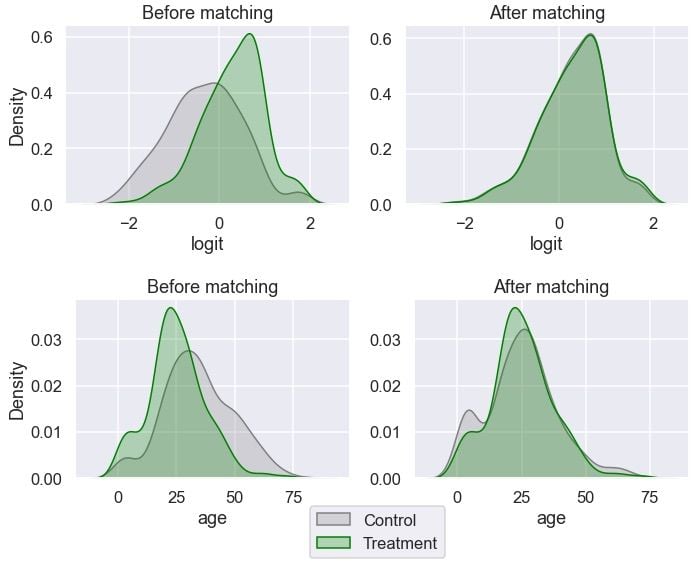
After matching, diagnostic checks ensure balance: the covariates between groups should no longer differ significantly. Only then can treatment effects be estimated with confidence.
It’s not magic—it’s mathematics meeting morality. PSM safeguards integrity, ensuring conclusions arise from causality, not coincidence.
Conclusion: The Ethical Compass of Data Science
Propensity Score Matching reminds us that data science is not merely about prediction or pattern detection—it’s about fairness. It’s the art of giving every observation an equal voice before drawing conclusions.
Whether applied to healthcare, education, or marketing, PSM ensures that decisions reflect truth, not bias. For those pursuing a data science course in Pune or training through a data scientist course, mastering techniques like PSM is a journey from numbers to nuance—from raw data to responsible discovery.
In the end, PSM is more than a statistical tool. It’s a quiet guardian of balance in the noisy world of real-world data—a reminder that in the orchestra of analytics, fairness is the most powerful instrument of all.
Business Name: ExcelR – Data Science, Data Analytics Course Training in Pune
Address: 101 A ,1st Floor, Siddh Icon, Baner Rd, opposite Lane To Royal Enfield Showroom, beside Asian Box Restaurant, Baner, Pune, Maharashtra 411045
Phone Number: 098809 13504
Email Id: enquiry@excelr.com






+ There are no comments
Add yours